
Snowshoe hare in the cedar swamp
Firearm deer season closes Nov. 30. Hare season runs to March, in conifer cover thick enough to hide the animal from hawks and owls.
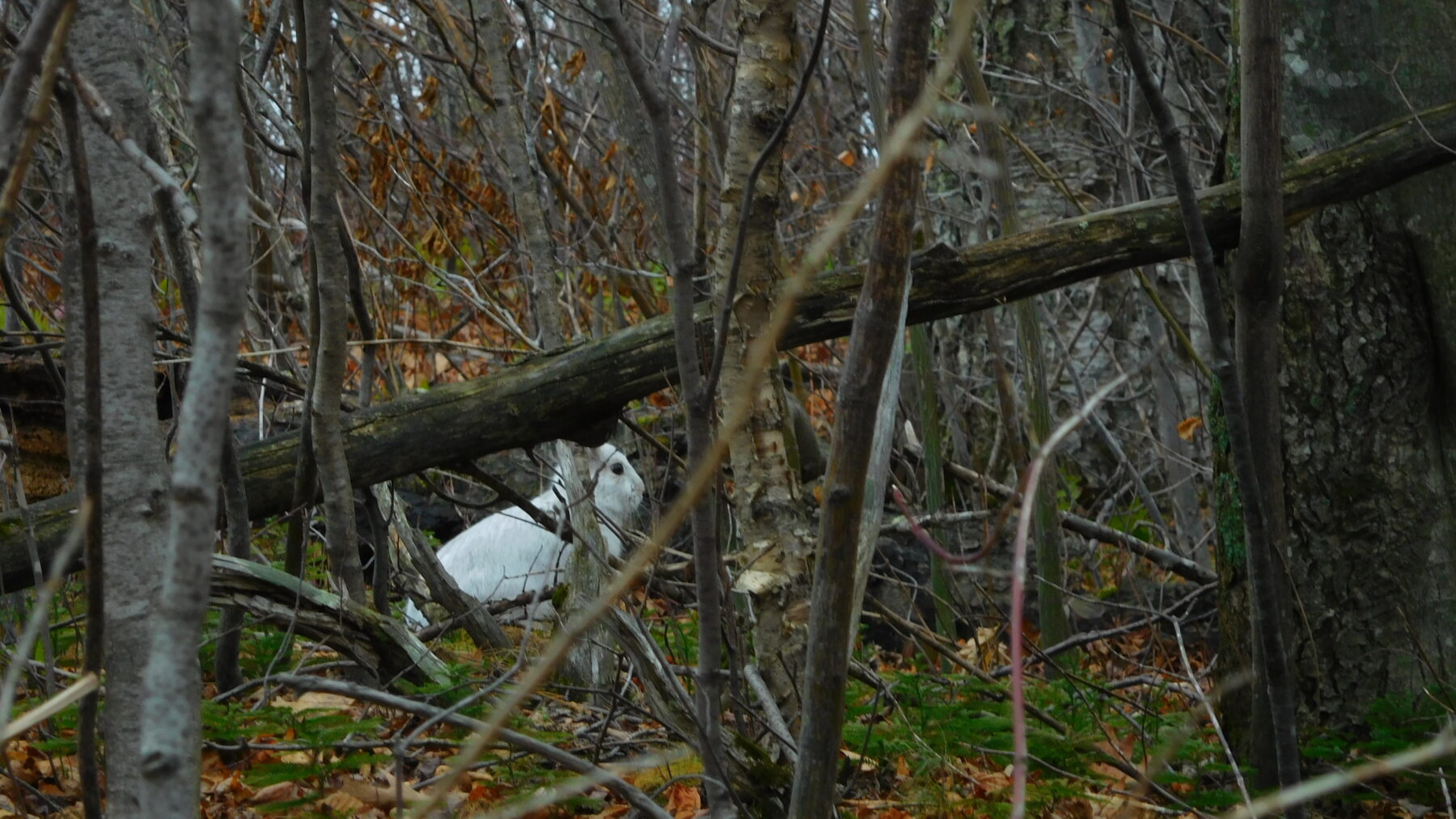
The firearm deer season closes Nov. 30, by the DNR’s 2026 small game regulations summary. The snowshoe hare season does not. It runs to the end of March, and through it the hare spends most of each day in a form, a shallow scrape it has worked out under ferns, brush or a pile of downed timber, and waits for dusk.
The short answer, from that same DNR summary: snowshoe hare is open statewide Sept. 15 to March 31, with a limit of five a day and ten in possession, hare and cottontail counted together, on a base license. You may hunt it with a dog during the open season, and from Aug. 15 through April 30 a small game hunter must wear hunter orange, a cap, hat, vest, jacket or rain gear, as the outermost layer and visible from all sides.
The foot and the coat
The Forest Service’s review of the animal gives it three names: snowshoe hare, varying hare and snowshoe rabbit. A grown one, by the University of Michigan’s Animal Diversity Web, is about 16 to 20 inches long and weighs a little over three pounds, and the female is the larger of the two.
The first name comes off the hind foot. The university’s page gives that foot as 117 to 147 millimeters, about 4.6 to 5.8 inches by our arithmetic, long and broad, with soles thick in fur and stiff hairs on the hind feet that make the snowshoe.
Then the coat. In summer it is a rusty or grayish brown over a white belly. In winter the hare is nearly all white, except for black eyelids and dark tips on the ears. The university’s page puts the change at about 72 days and says it “seems to be regulated by daylength.” The coat keeps the calendar, and no source read for this story gives a date by which Michigan’s hares are white.
Where it lives
Michigan’s hare belongs to a subspecies the Forest Service lists for Ontario, Manitoba, Saskatchewan, Michigan, Wisconsin and Minnesota. Its review puts the requirement plainly: dense, brushy cover, usually conifer. The university’s page names “cedar bogs and coniferous lowlands” among its homes, and the Forest Service’s lists of the forest types and plant communities it uses include northern white-cedar, tamarack, black spruce, balsam fir and conifer bog.
Cover counts for more than food. The Forest Service calls the presence of cover the main measure of good hare ground, ahead of what there is to eat, and finds that a thick softwood understory holds more hares than hardwood does. The best of it is young forest, second growth crowded with brush and saplings.
The review gives that cover a height. Heavy cover ten feet off the ground hides a hare from hawks and owls; heavy cover about three feet tall hides it from animals on the ground. In winter its activity usually moves into the conifer understory.
How it spends a winter day
The hare is out at dusk, through the night and at dawn, and it is out all winter. It travels mostly on paths of its own, trampled down through the vegetation, and keeps to a small piece of ground: about 7 to 17 acres by the university’s figures, our arithmetic from its square kilometers, and 14.6 to 25 acres in western studies the Forest Service cites. When food runs short it will wander as far as five miles. There is some evidence, the review says, that hares keep out of the open under a bright moon.
After the first frost it lives on buds, twigs, evergreen needles and bark until spring, preferring stems up to a quarter inch thick. In one Ontario study, northern white-cedar and balsam fir were among the trees it barked heavily. Deep snow helps it feed, lifting it to branches it could not reach before.
How it gets away
A running hare can reach about 27 miles an hour and cover up to ten feet in a bound. The university’s page describes sharp changes of direction and straight-up leaps that may leave a predator misjudging where it is. Young hares often freeze; older ones are more likely to run. It swims, and has been seen going into water to get away.
Bobcats, fishers, martens, foxes, coyotes, great horned owls and goshawks are among what hunts it, and as many as 85 percent of snowshoe hares do not live past a year, by the university’s page. Across the north of the range its numbers rise and fall on a cycle of about ten years, and toward the south they swing far less. No source read for this story says which Michigan is.
A dog, a property line and the table
The DNR’s 2026 small game regulations summary allows hare to be hunted with a dog in season, and it allows something a dog hunter will need sooner or later. Unless the landowner has forbidden it beforehand, you may walk onto another person’s property for the sole purpose of getting your dog back. You may not carry a firearm while you do it, and you should not stay longer than the job takes. A wounded animal is different: if it goes onto private property, the summary says, it may not be followed without the landowner’s permission.
The same summary rules out ferrets, snares and traps for small game, and on public land it forbids cutting branches, limbs or other vegetation for shooting lanes. It describes itself as a condensed version of the Wildlife Conservation Order, and its rules apply through July 31, 2027.
The hare is eaten, and in some remote places it matters as food. The DNR’s summary calls the risk of tularemia in Michigan low, especially in the colder months, and says an animal that looks sick or has white spots on the liver should not be eaten. A hare or rabbit found dead with blood at the nose and mouth and no plain cause should go to the DNR Wildlife Health Section, 517-336-5030.
Finding the cover
The DNR says it manages more than 4.5 million acres of public land open to hunting. Its MiHunt map, at Michigan.gov/MiHunt, shows the approximate bounds of land open to public hunting and, the department’s where-to-hunt page says, ground cover types. For an animal that lives by its cover, that is the layer to read.
By full light the hare is back in its form under the brush, sitting out the day until dusk.
Sources
Every rule in this story comes from a Michigan DNR page read on Nov. 27, 2026, and each sentence that states one names the page. Facts about the animal come from a US Forest Service review and a University of Michigan species account. Nothing here describes how to hunt hare behind a dog, and no part of Michigan is named as hare country, because no source read says either.
The DNR. 2026 Small Game Hunting Regulations Summary (web copy), which says its rules apply through July 31, 2027; a long document searched for hare, orange, private land, Mi-HUNT and training, with the passage around every hit read. Small game hunting in Michigan, read whole, for the season, limit and license. Where to hunt, read whole, for MiHunt; the map itself was not opened. Shooting hours and legal firearms for small game were not looked for and are not stated.
The animal. US Department of Agriculture, Forest Service, Fire Effects Information System, Lepus americanus, by Janet Sullivan, 1995: a review of studies made mostly outside Michigan. Where a figure rests on a study from Minnesota, Ontario, the Pacific Northwest or the western states, the story says so. University of Michigan Museum of Zoology, Animal Diversity Web, Lepus americanus, last updated 2007, for size, the foot, the coat and its change, speed, escape and survival; two short phrases are quoted from it. The Forest Service review says nothing about the coat change. The home range figures differ by study and are given as a range. Conversions marked as our arithmetic are the magazine’s.
What no source read settles. No source gives a date by which Michigan hares turn white, a count or trend of hares in Michigan, or whether Michigan sits in the cycling north of the range or the steadier south.