
What to do with a band on a duck or goose
A federal form, about two minutes by its own estimate, leads to where and when the bird was banded.
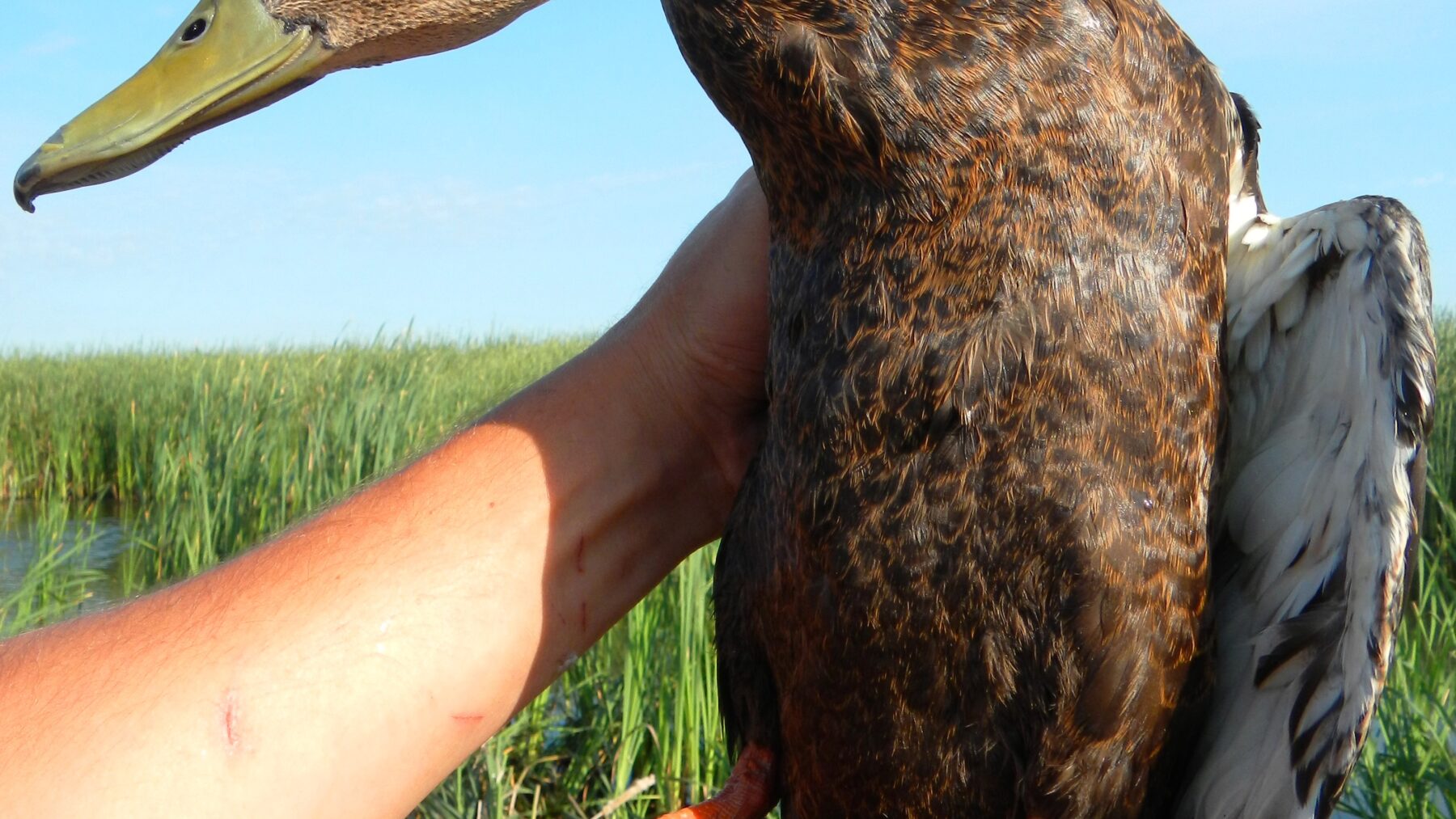
You have a duck or goose in your hand, and it is wearing a metal band with eight or nine digits on it. To learn where the bird was banded, go to reportband.gov and enter the number, the place, the day and how you came by the bird. The U.S. Geological Survey’s Bird Banding Laboratory will send back a certificate with its species, sex and age, and where and when it was banded. “You can keep the band,” the U.S. Fish and Wildlife Service says on its banding page.
Reporting is voluntary. The form puts the job at about two minutes and comes in English, French and Spanish. Have the band in front of you, know where the bird came down, and expect to give your contact information.
Filling in the form
The first question is who you are. A hunter checks the line for the finder, or for someone reporting on the finder’s behalf. Then say what you have: a federal band, a federal band and a color marker from the same bird, or a color marker alone.
The band number goes in as two parts with a hyphen between them. Look the bird over before you type. There is a box for a second federal band and another for a reward band, each with its own number. If you do not know the species, “Duck” and “Goose” are on a list of general types.
For how the bird was obtained, the first choice is “Shot.” The form also asks whether the band is off the bird or still on it, and what condition the band and the bird are in.
It wants the exact date and will take less. If the day is gone from memory, you can give the month and year, the year alone, or a hunting season. This fall’s reads “September 2026 – March 2027.”
The place can be the name of a refuge, management area or park, a street address, a point on a map or a pair of coordinates. It can also be given by the county and the nearest town, with the distance and direction from it.
Your name, email, phone and address come next, with one question to slow down for: whether you want the certificate by email. Review the page and press “Send to BBL.” Afterward the site lets you upload photographs of the band or the bird. A second banded bird gets a report of its own.
Worn numbers, money bands and pigeons
A band can wear until some or all of the digits are gone. The form has a path for one too worn to read. The Service says to email the laboratory at [email protected] or find out how to send the band in for chemical etching. Most bands can be etched so the numbers can be read, and the band comes back to you.
A reward band, which the Service also calls a “money” band, brings a check. They are relatively rare, the Service says, and a bird with one should also carry a standard band. Report both. If only the reward band is left, report that, and someone will contact you to finish the job so you get the certificate and the check. The pages we read do not say how much the check is for.
Some birds carry color instead, or as well. The form lists neck collars, leg flags, wing tags, colored leg bands and nasal saddles among its markers. For a neck collar, it asks for the code, the color of the marker and the color of the code.
One kind of band the laboratory does not want. The letters AU, IF, CU, NPA or IPB mean it is probably a captive pigeon band. The laboratory keeps no database of those birds and asks you not to report them.
The certificate
The certificate has been electronic only since July 2011. It arrives by email once the report is processed, if you asked for it, or you can download it with the band number and your first and last name. If you reported a band before and want another copy, the form’s opening screen has a link. The pages we read do not say how long processing takes.
What the number is for
Crews catch waterfowl where they gather to molt or to stage before the fall migration, and the banding done in August comes ahead of the hunting season. Then the reports come in. The North American Bird Banding Program, which the laboratory runs with the Canadian Wildlife Service’s Bird Banding Office, receives more than 60,000 of them from hunters a year. Banding data go into the yearly calculation of waterfowl harvest rates, and biologists use them in setting the annual regulations.
Not everyone reports, which is why reward bands exist. Biologists use them to estimate how likely it is that someone who shoots a banded bird will report it. Some people “falsely believe” that reporting could bring more restrictive regulations, the Service says. By its account, more reports mean more confidence in the data, which “allows us to set seasons that allow more harvest opportunity, while ensuring that the harvest is sustainable.”
Before the mid-1990s, reporting a band meant writing a letter to the laboratory. Then a toll-free number went onto the bands, and reporting rates more than doubled. If the band in your hand is stamped with a 1-800 number, leave the phone alone. Since July 2, 2017, the Service says, that report can be made only at reportband.gov.
Sources
All pages were read Nov. 24, 2026. The form was read and not submitted.
- U.S. Geological Survey, Bird Banding Laboratory: the report form at reportband.gov: the steps of the form, the time estimate, worn and pigeon bands, and the electronic certificate.
- U.S. Fish and Wildlife Service: Bird Banding, A Conservation Tool within the Migratory Bird Program: what to have ready, keeping the band, etching, reward bands, the end of phone reports, and the Service’s account of how reports are used.
- U.S. Geological Survey: Bird Banding Laboratory: the program, harvest rates and the yearly number of reports from hunters.
- U.S. Geological Survey: Banding Together, Dec. 20, 2024: where crews catch ducks, and banding before the season.
- Photograph pages of the U.S. Fish and Wildlife Service and the U.S. Geological Survey, read for picture rights only: banded black duck, duck banding and banded white-fronted geese.
No Michigan agency page was used, and no season, limit or shooting hour is stated. The pages read give no reward amount and no wait for a certificate.